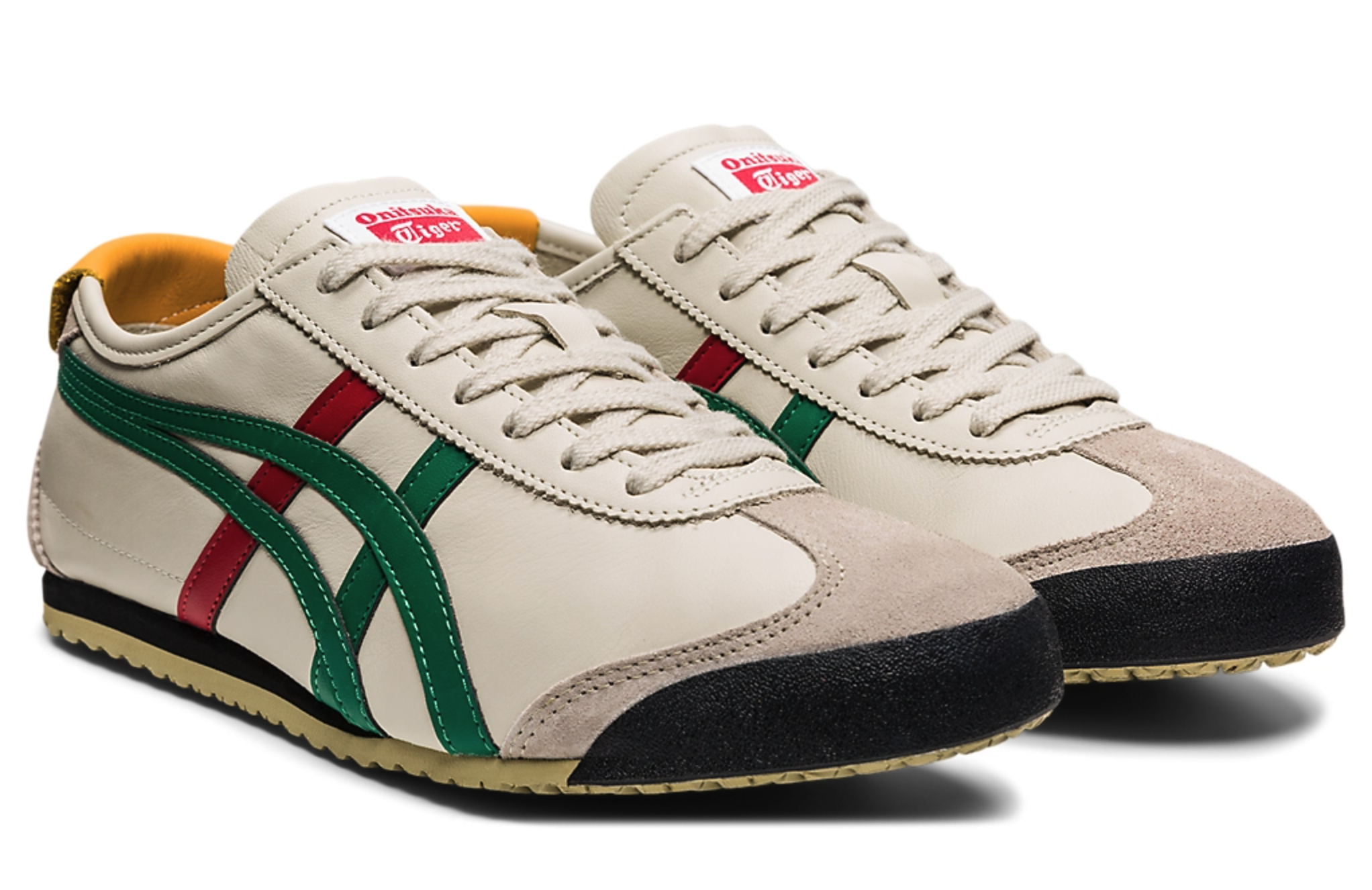
Mexico 66
Why this is a BIFL buy
Nearly 60 years of continuous production is the longest quality endorsement in footwear. The leather upper ages gracefully, colorways never go out of style, and replacement pairs cost under $100 — making this genuinely buy-it-for-life footwear.
Full Review
The Mexico 66 came in 1966 — originally called the Limber Up, designed for Olympic pre-trials, worn by the Japanese national team at the 1968 Mexico City Games. It was the first shoe to feature the diagonal Tiger Stripes that became the signature mark of both Onitsuka Tiger and ASICS.
The silhouette has not changed in any meaningful way since. That is the point. It is a low-top with a slim profile, a flat rubber sole, and those stripes running from toe to ankle. What it has is proportion — correct, in the way that a well-designed chair is correct: nothing to add, nothing to remove.
The cultural record is unusual for a running shoe. Its association with Bruce Lee's yellow-and-black colorway via his 1978 film cemented it as an object of cinematic mythology. Kill Bill reinforced it in 2003. Neither moment was engineered — the shoe simply appeared in the right place and let the culture do the rest.
At roughly $90 USD retail, it is among the most accessible pieces of genuine Japanese athletic heritage available. Onitsuka Tiger net sales increased 61% in the first half of 2024, driven in part by the flat low-profile sneaker trend — but the Mexico 66 was doing this before it was fashionable.
Who is this for?
Anyone who wants a versatile, heritage sneaker that works equally well with jeans, chinos, or a suit. Particularly well-suited to Japan travel — a pair of Tigers on the streets of Tokyo feels exactly right.
Any downsides?
The sole is thin and cushioning is minimal — extended walking days require a quality insole or the upgraded SD variant. They run generous; size down a half.